
Plan a drone parts sample request with a clear brief, acceptance criteria and evaluation checklist. Record the decision before moving to a production order.
A useful drone parts sample request names the decision, exact item, evaluation owner, authorized method, evidence and possible outcomes. If nobody owns the decision, no approved method exists or no criterion can change the purchase decision, do not ship the sample yet.
One satisfactory sample does not approve every future unit or configuration. It can reduce a defined uncertainty and support a limited next step; production identity and any required lot acceptance remain separate.
Complete this sentence first: “After this evaluation, [named decision owner] will decide whether to ___, using ___ evidence by ___ date.” A decision might be to request a production quotation for one reference, reject a proposed alternative, or plan a second authorized evaluation.
Do not write “test the sample” without saying what uncertainty the work should resolve. A dimensional check cannot answer a protocol question; a neat appearance cannot establish durability; a catalog photo does not establish production consistency.
NIST explains that lot acceptance sampling uses a sample selected from a lot to make an accept/reject decision about that lot; its main purpose is not to estimate general product quality. A supplier-selected pre-order item is therefore not a production-lot sampling plan.
Do not call one demonstration item an AQL inspection or use it to promise that later shipments will pass. When formal sampling is required, use a qualified quality process with its own lot definition, selection method and decision rules.
| Field | What to agree |
|---|---|
| Decision | The exact next decision and its owner |
| Identity | Manufacturer reference, revision, option and condition |
| Sample origin | Stock, normal production, specially prepared or unknown |
| Quantity and contents | Samples, pack units, accessories and exclusions |
| Evaluation | Authorized method, responsible evaluator and applicable documents |
| Criteria | Criterion, evidence, result vocabulary and stop condition |
| Timing | Dispatch estimate, review date and expiry/recheck date |
| Commercial terms | Charge, delivery responsibility and any agreed later credit |
| Outcomes | Limited approval, more evidence, replacement sample, rejection or closure |
Sample request — replace every bracketed field

Decision to support: [specific purchasing decision]
Item: [manufacturer reference, revision and option]
Quantity/package: [sample units and included items]
Sample origin: [stock / normal production / specially prepared / unknown]
Evaluator and method: [responsible party and approved procedure]
Evidence required: [documents, observations and report]
Review date: [date]
Possible outcomes: [limited approval / more evidence / replace / reject / close]

Please confirm charges, delivery scope and any difference between this sample
and the item that would be supplied in a later production order.
State forecasts honestly. Do not promise a volume order to obtain a discount. A promotional program is also different: Hobbywing’s official Product Testing Program invites an application for a chance to join; submitting the form does not confirm participation or supply.
Define the configuration, check, conditions, acceptance criterion and evidence before a sample is produced or shipped. The following rows are illustrative review formats. They contain no observed result and do not claim that DroneNook has tested these products.
| Sample ID | Configuration / revision | Check item | Method / conditions | Acceptance criterion | Observed result | Evidence file | Reviewer / date |
|---|---|---|---|---|---|---|---|
| To assign | Case shell and proposed foam-layout revision | Equipment placement, connector clearance and removal space | Place the named equipment in the agreed layout and record the defined clearances. | Criteria to be agreed against the selected shell drawing and layout revision. | Layout drawing and dated photos to be added | To assign | |
| To assign | Decal material, finished size and application surface | Fit, application and demonstration-code readability | Apply the identified sample to the specified prepared surface and record the agreed observation conditions. | Criteria to be agreed for the named surface, dimensions and code content. | Material record, surface photo and reading record to be added | To assign | |
| To assign | LED module, controller, supply and wiring configuration | Observation under the agreed electrical and mechanical setup | A qualified evaluator follows the approved method for the stated supply, controller and connection. | Criteria to be agreed for the stated configuration; this guide does not provide an energizing procedure. | Configuration record and authorized observation file to be added | To assign |
Sample review record
Sample ID and configuration:
Check item and agreed method:
Conditions and equipment used:
Acceptance criterion agreed before the check:
Observed result (complete after checking):
Photo / measurement file:
Decision: accepted / changes required / not yet checked
Reviewer, date and next revision:Agree the configuration, checks and acceptance criteria before reviewing the sample. Record the conditions, observed results, photos or measurements, reviewer and date. Mark each check as accepted, changes required or not yet checked. A sample result applies to the reviewed configuration and conditions; it does not automatically establish performance for every production unit or operating environment.
Sample charges, freight, any later credit and timing require written confirmation for the specific project. This guide does not promise free samples, a fixed lead time or a refund policy.
Gate 1 — Receipt and identity. Confirm the reference, revision, condition, quantity and included items against the brief. A mismatch stops the planned evaluation until disposition is agreed.
Gate 2 — Authorized evaluation. The responsible evaluator follows the applicable method and records conditions, evidence and limitations. This purchasing guide does not instruct readers to energize, load, expose to chemicals or flight-test a component.
Gate 3 — Commercial decision. The decision owner states exactly what the result permits. “Proceed to a quotation for reference X under conditions Y” is usable; “sample looks good” is not.
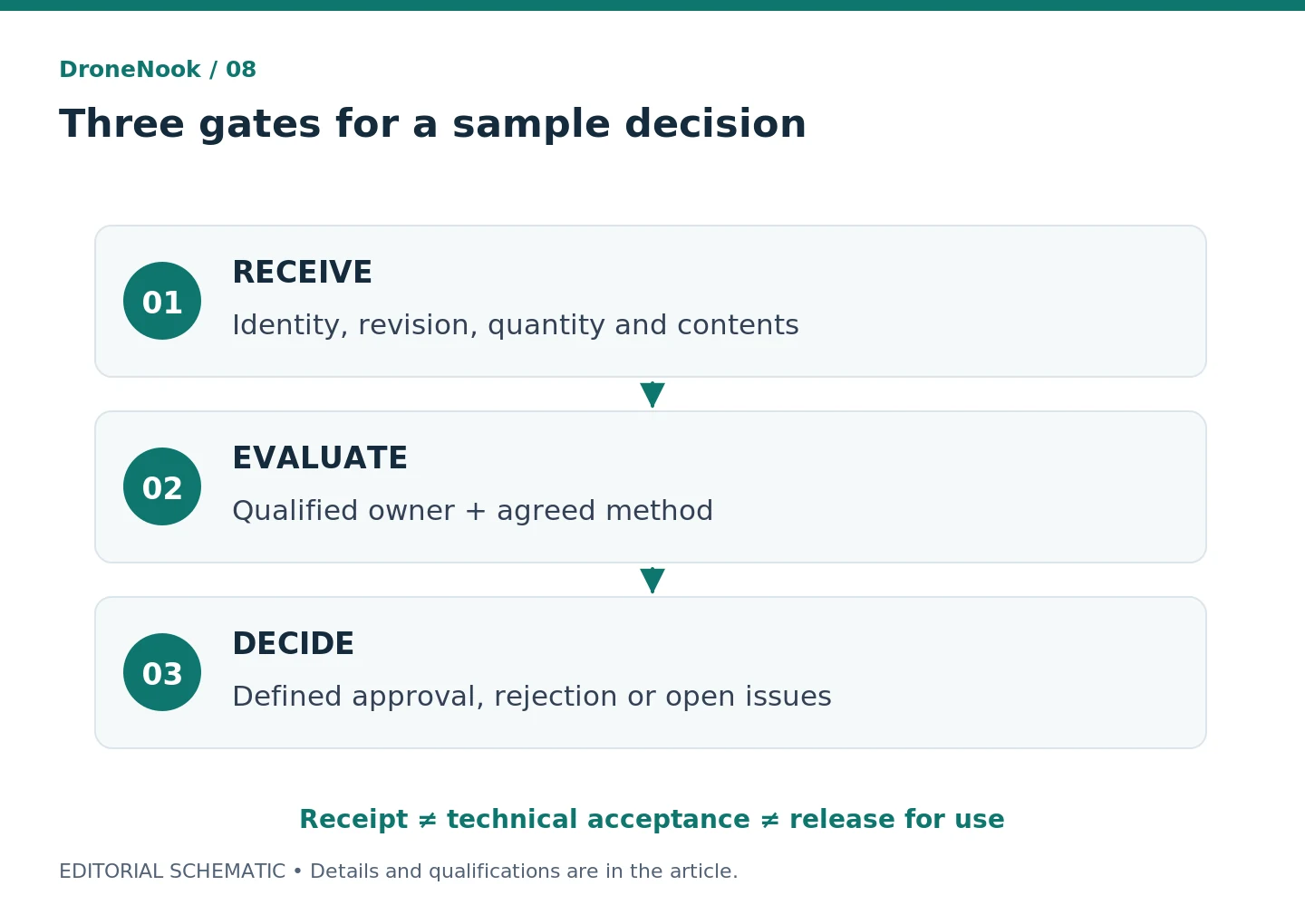
Each gate has a different owner and result. Passing one gate does not skip the next.
| Criterion | Evidence | Result | Owner | Next action |
|---|---|---|---|---|
| Reference and revision match | Label photo and brief | Pass / fail / pending | Receiving contact | Continue / hold discrepancy |
| Package complete | Confirmed packing list | Pass / fail / pending | Receiving contact | Continue / request missing item |
| Defined technical criterion | Authorized evaluation report | Pass / fail / pending | Qualified evaluator | Decision / further evidence |
| Production follow-through | Identity and change commitments | Agreed / open | Buyer and supplier | Quote / clarify / close |
A pending result needs three fields: missing evidence, owner and next review date. Silence is not acceptance. Retain raw observations and photographs with the final summary.
Ask whether a later supply will retain the same reference, revision, materials relevant to the decision, package contents and declared process. If the sample was specially prepared, record that fact; do not assume it represents a normal catalog item.
A replacement or revised sample starts a new record. Link it to the previous one, list the change, identify affected criteria and issue a new decision. Do not overwrite the failed or obsolete record.
For source and alternative-part questions, use the OEM-versus-aftermarket decision guide.
Write the observed fact, evidence, affected criterion and requested disposition. “Label shows revision C; brief requires B” is a supply discrepancy. “The design is defective” may be an unsupported diagnosis.
Before a production order, reconfirm four things: same product identity, same package scope, every declared change reviewed, and current commercial terms. Reference the sample record and state the limited decision it supported.
A pre-order sample approval does not replace receiving checks or formal production-lot acceptance. If the later order needs a statistical plan, define it separately with the qualified quality function.
Confirm identity, quantity, included items, sample origin, charge, delivery scope, dispatch estimate and any later credit. Attach the decision brief rather than relying on “one sample please.”
No. Limit the decision to the documented item, criteria and purpose. Reconfirm production identity and apply any required lot acceptance separately.
Only when that person has the required competence, authority and approved method for the actual task. A sales title alone provides none of those.
Mark the decision pending, name the missing evidence and owner, and set a new review date or close the task. Do not convert silence into acceptance or a promised order.
Use the RFQ guide to identify the item and the package guide to define contents. Browse the DroneNook range, or send the sample brief and open decision for a scope review. Availability, charges and technical arrangements require confirmation.
Prepared by Amao Zhao, an independent sourcing contact based in Shenzhen, China. DroneNook helps buyers clarify civilian drone and component requirements and coordinate supplier discussions. Product capabilities and sample acceptance are confirmed for each project. About the author and sourcing process.
The brief, gates, checklist and request block are original purchasing aids, not a certified inspection plan or evidence that DroneNook has tested a product. Sources checked 22 October 2026.