
Choose an FPV drone ESC by checking battery and motor load, current-rating conditions, FC pinout and protocol, stack fit, firmware, cooling, and replacement records.
To choose an FPV drone ESC, verify the complete power system and flight-controller interface: battery range, motor/propeller load, current-rating conditions, mounting pattern, board outline, connector or pinout, firmware, telemetry, configuration, cooling, and replacement documentation.
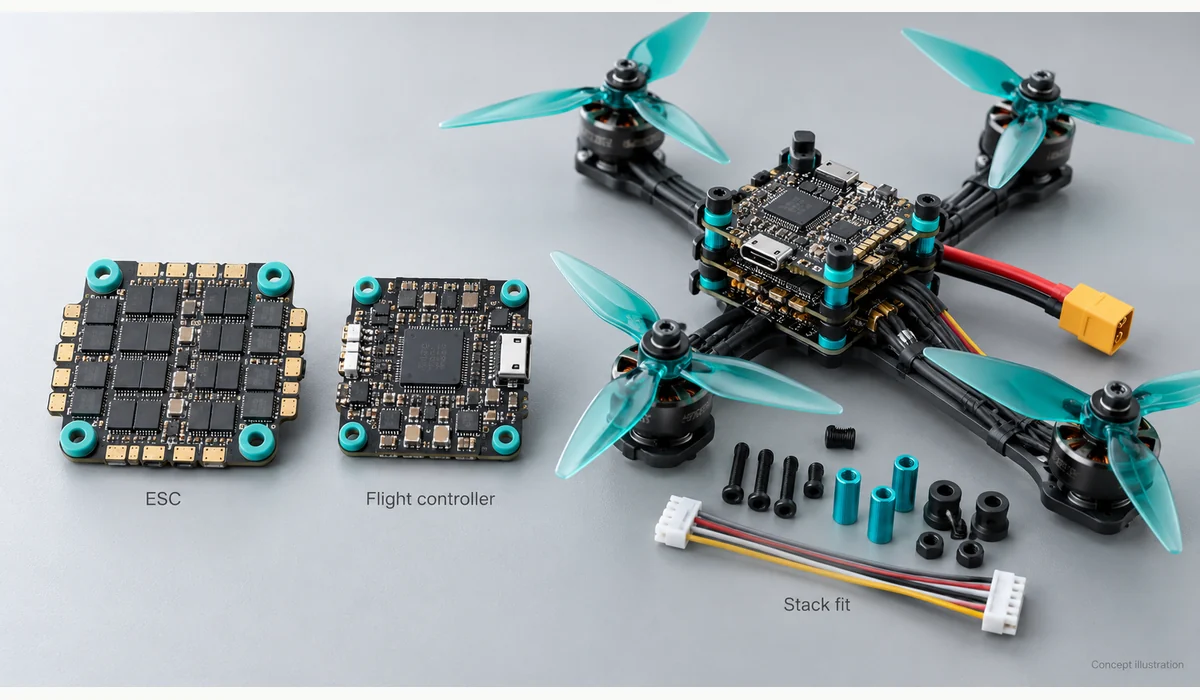
An FPV ESC controls motor power from flight-controller commands. FPV builds may use individual ESCs or a multi-channel board; an FPV stack combines mechanically aligned electronics but does not guarantee electrical compatibility. Record whether the requirement is a complete build, replacement board, or FC/ESC pair. For replacement, identify the failed board and connected components before choosing by headline current alone.
Use FPV ESC manufacturer documentation for battery input, continuous and burst current with stated conditions, supported firmware, motor outputs, auxiliary power, capacitor guidance, and cooling or airflow assumptions. Compare motor model, propeller, aircraft mass, battery, and expected use. Current labels from different vendors may use different test conditions, so identical numbers do not prove equivalent capability.
Measure mounting-hole pattern, board outline, stack height, component clearance, connector location, cable length, and access. For FPV ESC and flight controller compatibility, confirm the connector pinout, voltage and ground arrangement, motor signal order, current-sensor and telemetry paths, and any required harness. A plug that fits physically can still have a different pinout. Use exact manuals and continuity checks under a qualified repair process.
Inspect soldering, insulation, fasteners, capacitor and cable retention. Use appropriate current-limited first power-up equipment and a bench procedure created by a competent technician. Confirm communication, motor order and direction without props, then restore configuration and perform controlled flight acceptance. Keep the removed part ID, installed part ID, firmware, configuration and test record.
| Review area | Evidence or decision to record |
|---|---|
| Electrical | Battery, rating conditions, motor/prop load and cooling |
| Mechanical | Hole pattern, outline, height and connector clearance |
| Interface | Pinout, motor order, telemetry and sensor path |
| Replacement record | Part IDs, firmware, configuration and acceptance |
Attach the exact FPV drone ESC and FPV flight controller manuals, then resolve electrical ratings, rating conditions, pinout, motor order, telemetry, mechanical fit, cooling, firmware, and first-power-up procedure before treating the candidate as a replacement.
A damaged racing drone ESC has the same mounting-hole pattern as a candidate replacement. The worksheet still flags board outline, stack height, harness pinout, current-sensor path, motor order, battery rating, firmware, and connector clearance. If the pinout differs, a physically fitting plug can cause damage. If the current label matches but its test conditions do not, the rating comparison remains open.
The replacement record should attach source manuals and photographs, name the technician, and capture bench and flight acceptance. This creates a recoverable maintenance history instead of teaching future technicians that “same size and amps” is enough.
The Betaflight ESC guide explains the ESC role, FC-to-ESC protocols, firmware and telemetry paths. The AM32 firmware project lists supported protocols and MCU families, and requires the firmware target and bootloader to match the actual ESC hardware. These references support interface checks; the exact ESC manufacturer documentation remains the source for electrical ratings, cooling, pinout and motor/propeller limits.
DroneNook does not claim that every AM32 ESC, matching hole pattern, or similar current label is compatible. Send both board identities, manuals, motor and propeller configuration, battery family, and photographs through the DroneNook contact form for review. If sourcing an assembled aircraft, compare the open-propeller FPV reference configurations and confirm the ESC revision in the selected build.