

Check whether your radio and receiver match an ELRS cinewhoop. Record frequency, firmware and flight-controller support separately from video equipment.
An ELRS cinewhoop is compatible with an existing radio only when the transmitter setup and receiver use the same ExpressLRS frequency family, the hardware and firmware are appropriately configured, and the flight controller interface is documented. ELRS identifies the cinewhoop control link; it does not identify whether the aircraft is an analog cinewhoop or an HD cinewhoop.
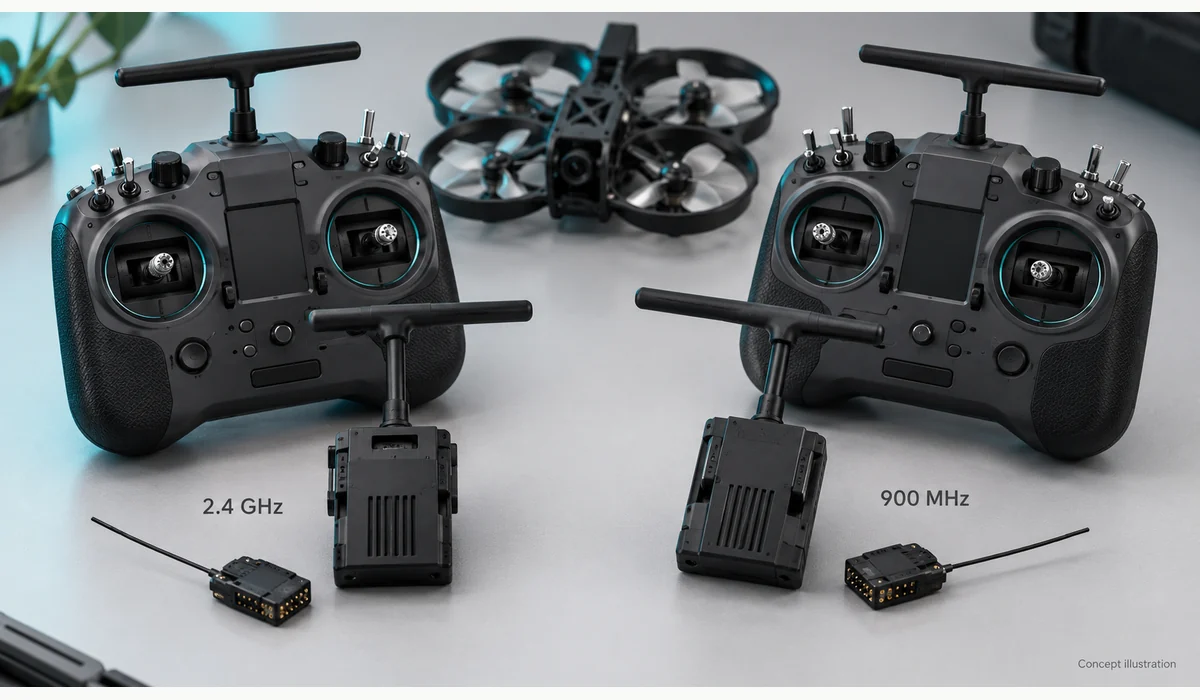
The cinewhoop control link runs from the pilot’s radio through a transmitter module or internal transmitter to the aircraft receiver and flight controller. The cinewhoop video link runs from camera and video transmitter to goggles or another receiver. A buyer may encounter ELRS control with either analog or digital video. Confirm both paths independently; use the analog vs digital cinewhoop guide for goggles and recording decisions.
| Layer | Record | Why it matters |
|---|---|---|
| Radio | Manufacturer, model, operating system/version | Defines the operator interface and module support |
| Transmitter | Internal/external, exact model, frequency family, firmware | Must be evaluated against the receiver |
| Receiver | Exact model, antenna arrangement, firmware, installed location | Hardware and installation affect the offered configuration |
| FC interface | Port, protocol, configuration evidence | Connects receiver output to the flight controller |
| Bind/setup | Binding method and configuration owner | Makes handover repeatable |
| Acceptance | Control, telemetry, failsafe test record | Proves only the functions actually tested |
Cinewhoop radio compatibility is established for the named transmitter, receiver, frequency family, firmware, interface, and configuration—not by the ELRS label alone.
The official ExpressLRS hardware selection guide states that transmitters and receivers must use the same 2.4 GHz or 900 MHz frequency family and treats receiver size, antenna placement, diversity, and flight profile as selection factors. This does not prove compatibility or range for a particular assembled aircraft.
ExpressLRS also documents multiple receiver output options in its serial protocol guide. The exact receiver pads and flight-controller configuration still need their own documents; a generic wiring diagram should not be reused across unknown hardware.
The official ExpressLRS binding guide requires the transmitter and receiver firmware major versions to match: 3.x devices can work across minor releases, while a 3.x/2.x pairing cannot bind. Record the full versions for handover. Built-in SPI receivers need a separate check because their ExpressLRS support is tied to the flight-controller firmware.
Ask for a screenshot or export showing the installed versions, the agreed binding method, and who completes setup. A binding phrase is configuration data, not evidence of a tested installation; you do not need to send its actual value in a purchasing inquiry. Identify whether the aircraft arrives ready to bind or needs setup by your operator. The cinewhoop kit checklist helps record which equipment and setup work the quotation includes.
Changing an analog cinewhoop to an HD cinewhoop option may change airframe packaging, power needs, camera, transmitter, antennas, goggles, and recording workflow. It does not automatically change the ELRS control link. Conversely, changing the receiver or radio configuration does not establish video compatibility. Keep the two evidence records separate even when a supplier offers them as dropdown options on one aircraft page.
For every accepted batch, save the exact transmitter, receiver, frequency family, firmware major version, flight-controller target/version, configuration backup, antenna installation photos, and verified functions. Mark substitutions explicitly. When a later batch uses a different receiver, repeat the checks rather than copying the old conclusion.
A useful result field is one of four values: verified on the named setup, conditionally supported pending a test, unsupported, or unknown. “Both are ELRS” is not a result.
Do not assume that a frequency label is permitted in every destination. The buyer and operator must verify applicable local requirements. Likewise, do not publish range figures without a defined configuration, environment, method, and source.
When reviewing the 2.5 and 3.5 inch Cinewhoop references, identify the exact receiver option rather than assuming every configuration includes ELRS. Send your radio model, transmitter-module model, frequency family, known firmware versions, required aircraft quantity and destination through the parts inquiry checklist or contact DroneNook. Receiver availability and compatibility with the submitted setup must be confirmed in the quotation.