Choosing between OEM and aftermarket drone parts is not a single quality decision. Establish who made the item, who is selling it, what it is documented to fit, and who will support the transaction. A familiar brand name does not establish compatibility; a third-party manufacturer does not automatically make a product counterfeit or suitable.
The practical objective is a traceable, correctly identified part with an acceptable evaluation and support path. This guide addresses procurement of civilian drone components, not permission to modify an aircraft or a legal opinion on a warranty.
OEM vs aftermarket drone parts: separate four questions
A listing may use “original,” “OEM quality,” “compatible” and “factory direct” close together. Ask the seller to convert those phrases into specific statements.
| Question | Evidence to request | What it does not prove |
|---|---|---|
| Who made it? | Manufacturer identity and exact product reference | That this particular shipment is authentic |
| Who is selling it? | Seller’s legal identity, transaction record and any claimed authorization | That every listed item comes through that authorization |
| What does it fit? | Model, revision and documented compatibility conditions | That installation or operation is automatically approved |
| Who supports it? | Written discrepancy, return and technical-support arrangements | That every supplier has the same warranty terms |
Treat these as separate lines in your evaluation. Passing one does not close the others.
Use a working vocabulary, then confirm what the seller means
Original or genuine branded part describes the claimed origin. Ask whose brand and which manufacturer reference is meant. Do not accept a logo photograph as the entire source record.
OEM means original equipment manufacturer, but a sales listing may use it inconsistently: an original part, a manufacturer behind a branded product, or a general quality claim. Rather than arguing about the acronym, request the actual maker, reference and supply description.
Aftermarket part is a replacement offered outside the original branded supply arrangement. It needs its own manufacturer identity, specification and suitability evidence. Do not describe it as original merely because it resembles an original part.
Compatible part is a fit-and-function claim. Ask which exact configuration the claim covers, what supports it and what is excluded.
Used, repaired or refurbished part describes condition or processing, not brand authenticity. Keep it separate from “new” in a quotation and inventory record.
Counterfeit should not be used as a synonym for third-party. Suspected false branding or identity warrants investigation; a transparent third-party product should instead be assessed on its own evidence. These descriptions are procurement vocabulary, not a determination about any particular seller.
An authentic product can still be the wrong match
DJI’s Matrice 350 RTK FAQ points buyers to an accessory compatibility list and gives qualified answers for particular hardware and firmware combinations. That is an important distinction: even within one brand, support is tied to a documented configuration rather than the logo alone.1
Do not take an example from that platform as compatibility guidance for another aircraft. The purchasing lesson is to ask for the current reference that governs the item you are ordering.
For a third-party product, the same discipline applies. “Fits agricultural drones” is not a complete compatibility statement. A useful answer identifies the existing platform, component revision, connections and any conditions that the responsible technical party must verify.
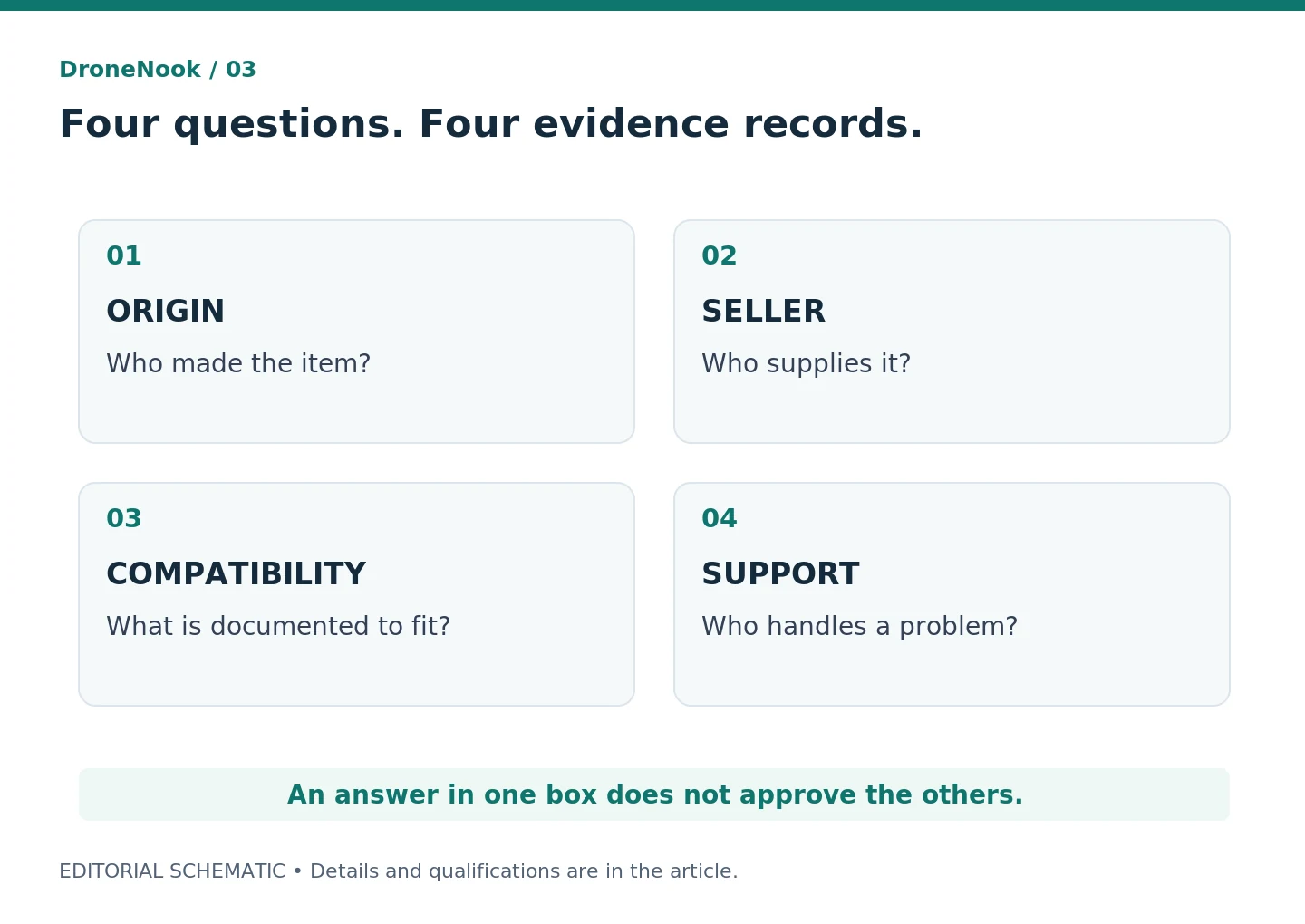
Evaluate these four questions independently. A green answer in one column does not approve the whole purchase.
Drone parts source verification before choosing a supplier
Start with records that can be traced back to a responsible party. Keep the quotation, exact item identity, claimed condition, source description, included items and any written compatibility statement together. Ask for product photographs specific enough to identify the offered version, without requiring unrelated private customer documents.
When authorization matters to the purchase, verify the claim through the manufacturer’s published contact or channel information rather than relying only on a logo copied into a quotation. Some manufacturers provide their own authenticity-check entry points; Hobbywing, for example, provides an anti-counterfeit-code interface on its official product site. That does not mean every component has the same verification method or that an interface result confirms suitability.2
Avoid demanding that every supplier disclose an entire upstream customer chain. Request the evidence appropriate to the transaction and evaluate what it actually establishes. If a supplier cannot meet an essential traceability requirement, mark the requirement as unmet instead of replacing it with confidence in the seller’s tone.
Compare an original option and a third-party option fairly
Create separate quotation lines. Do not put the aftermarket offer beneath the original reference without naming the alternative manufacturer.
A useful comparison includes the exact item, condition, compatibility evidence, included accessories, available documentation, evaluation required, delivery scope and support arrangement. Price is one field, not the heading for the entire decision.
Consider this fictional purchasing situation:
| Evaluation point | Option A | Option B |
|---|---|---|
| Stated origin | Original branded replacement | Named third-party replacement |
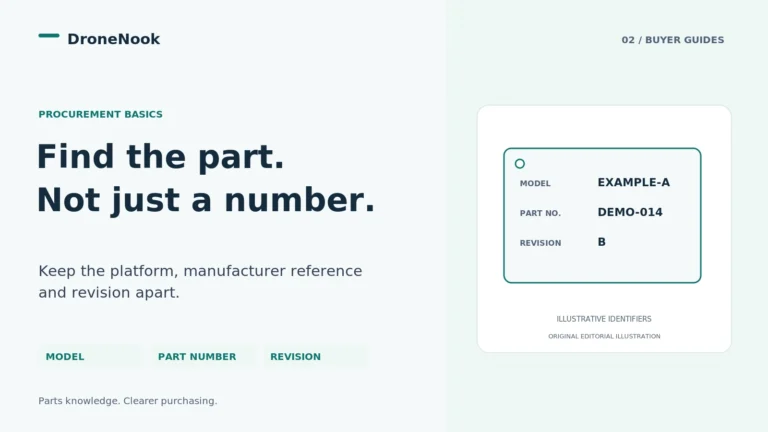
| Identity | Exact reference and revision supplied | Alternative reference supplied |
| Compatibility | Supported configuration identified | Supplier says “similar”; evidence not yet supplied |
| Contents | Defined | Defined |
| Current purchasing status | Continue commercial review | Hold for technical clarification |
The table does not say that original products always win. It shows why an unverified compatibility claim cannot be compensated for by a lower price. If Option B later supplies acceptable evidence and passes the agreed review, its status can change. If Option A has unclear condition or source, it also needs to be held.
Confirm drone component compatibility responsibilities
The buyer, original equipment maker or qualified integration/maintenance party must determine what is appropriate for the existing equipment. A sourcing contact can collect specifications and relay questions; that is not the same as signing off structural or flight-control suitability.
Record the exact decision: which product, which revision, which configuration, and which limitations. “Approved supplier” is too broad if only one sample of one item has been reviewed.
Do not use a purchasing article as an installation guide. A genuine part may still require approved installation, calibration or inspection steps. For a safety-relevant item, missing evidence should lead to a pause, not an improvised fit test or trial flight.
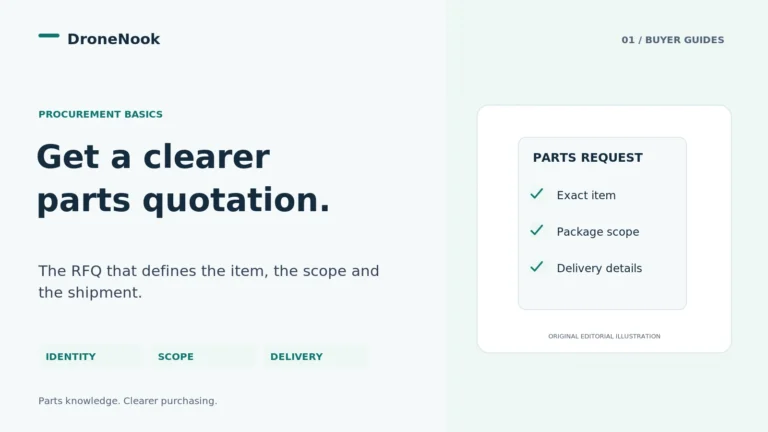
Use the drone parts RFQ checklist to record the boundary between commercial receipt, compatibility evidence, technical evaluation and authorization for use.
Review drone parts supplier documentation before payment
Ask whether the goods are new, unused old stock, refurbished, repaired or removed from equipment. Request disclosure of changed connectors, repaired wiring or other alterations relevant to the offered condition. Do not assume “tested” means new or that a cosmetic photograph shows the full history.
Define the procedure for a wrong reference, missing accessory or apparent defect. Identify the contact, records needed and responsibility for return or replacement arrangements. Do not assume an original manufacturer’s policy applies to an independent seller’s transaction without checking the actual terms.
Avoid blanket claims that using a third-party part always preserves or always cancels a warranty. Product terms, the nature of a problem and applicable rules can differ. Obtain the relevant written terms and suitable professional advice when the consequences matter.
Common questions
Does OEM quality prove original drone parts?
Not by itself. Ask for the manufacturer, exact reference, branding and source description. Treat the phrase as incomplete until it is translated into verifiable information.
Are compatible drone replacement parts always lower quality?
That conclusion cannot be drawn from the category name. Review the alternative’s documented properties, suitability evidence, consistency and support. Equally, do not assume a named manufacturer makes a part suitable for all platforms.
Can I compare quotations without buying samples first?
You can compare identity, package scope, documentation and commercial terms before a sample. Whether evaluation is required before use is a separate decision for the responsible technical party.
Can a supplier substitute a different brand after quotation?
Your order should specify whether substitutions are allowed. A practical purchasing rule is to require separate identification and written acceptance of an alternative rather than accepting an unnoticed change.
Turn claims into a decision record
Use the part-number guide to establish identity and the package-contents guide to establish scope. When sending a DroneNook inquiry, state whether you require a particular manufacturer’s item or are willing to review a clearly identified alternative. That preference is not, by itself, approval of a replacement.
Sources and scope
References checked on 4 October 2026. The evaluation matrix is an original editorial framework. No named product is being offered as an approved substitute, and no manufacturer relationship is claimed.