The aircraft model, the manufacturer’s part number and a reseller’s stock code are different identifiers. Record each separately, preserve any revision or option suffix, and verify the reference against the manufacturer’s documentation or written confirmation. Use photographs to support identification—not to replace it.
Correct drone part number identification starts with a question: which number identifies the exact thing you intend to receive? A search result may contain several numbers, but only some describe the component itself.
Six identifiers that can appear on one purchase
| Identifier | What it describes | How to use it |
|---|---|---|
| Platform model | The aircraft or larger equipment family | Provide context; do not use it as the only component reference |
| Manufacturer model | The product family’s commercial name | Preserve the spelling and any suffix |
| Manufacturer part number | A reference assigned by the manufacturer | Use as the main ordering identifier when available |
| Revision or option | A hardware revision or selected configuration | Record separately and do not discard it |
| Reseller SKU | A seller’s catalog or inventory reference | Map it to the manufacturer reference |
| Serial or batch identifier | An individual unit or production group | Keep for traceability; do not confuse it with the item ordered |
These are working distinctions for a buyer’s record. A manufacturer may use different labels, or combine the model and part number. The point is not to force every supplier into your terminology; it is to make the relationship explicit.
A real example: product number 3425 is not FS5106B
Pololu identifies a servo with its own product number 3425, while the manufacturer/model shown is FEETECH FS5106B. A purchasing sheet containing only “3425 servo” loses information when it is sent outside that seller’s system.1
A clearer line retains both: “FEETECH FS5106B; Pololu reference 3425.” This is a naming example, not confirmation that the servo is suitable for a particular aircraft or that DroneNook supplies it.
The same principle applies to an internal maintenance code. Your organization may call a part “PUMP-07,” but that name means little to a new supplier unless it is mapped to the original reference.
Where to look, in the right order
Start with the records that identify the existing configuration: the original purchase record, manufacturer parts diagram, current service documentation or an intact product label. Then use the supplier’s listing as a cross-check.
Do not remove or energize equipment just to look for a hidden number. When accessing a label requires disassembly, use the responsible technician and the relevant manufacturer procedure. Procurement staff can request the record without performing the work themselves.
For each candidate number, save the exact wording, where it appeared, the date checked and the related model or variant. A cropped screenshot with no URL or context can become difficult to interpret later. Keep an unedited source record alongside any annotated copy.
If a seller’s category page and the linked product page disagree, stop and request confirmation. A catalog link is a navigation aid, not a written statement that two revisions are interchangeable.
Capture photographs that answer identification questions
A useful photograph set normally separates three views: the overall component, the label or marking, and the relevant mounting or connection area. Add a packaging label when it contains a different reference.
Use readable lighting and an original-resolution file. Do not crop out the final characters of a code, cover a suffix with an annotation, or enhance an unreadable number until it looks certain. If text is not legible, report that limitation.
A scale can help describe an unidentified mechanical item, but the scale must be in the same plane as the feature and the image should not be treated as a precision drawing. Ask the supplier which dimensions are required before recording an extensive set of measurements.
Avoid publishing customer serial numbers, private addresses or internal labels in public forum posts. Share necessary information privately with the party handling the identification.
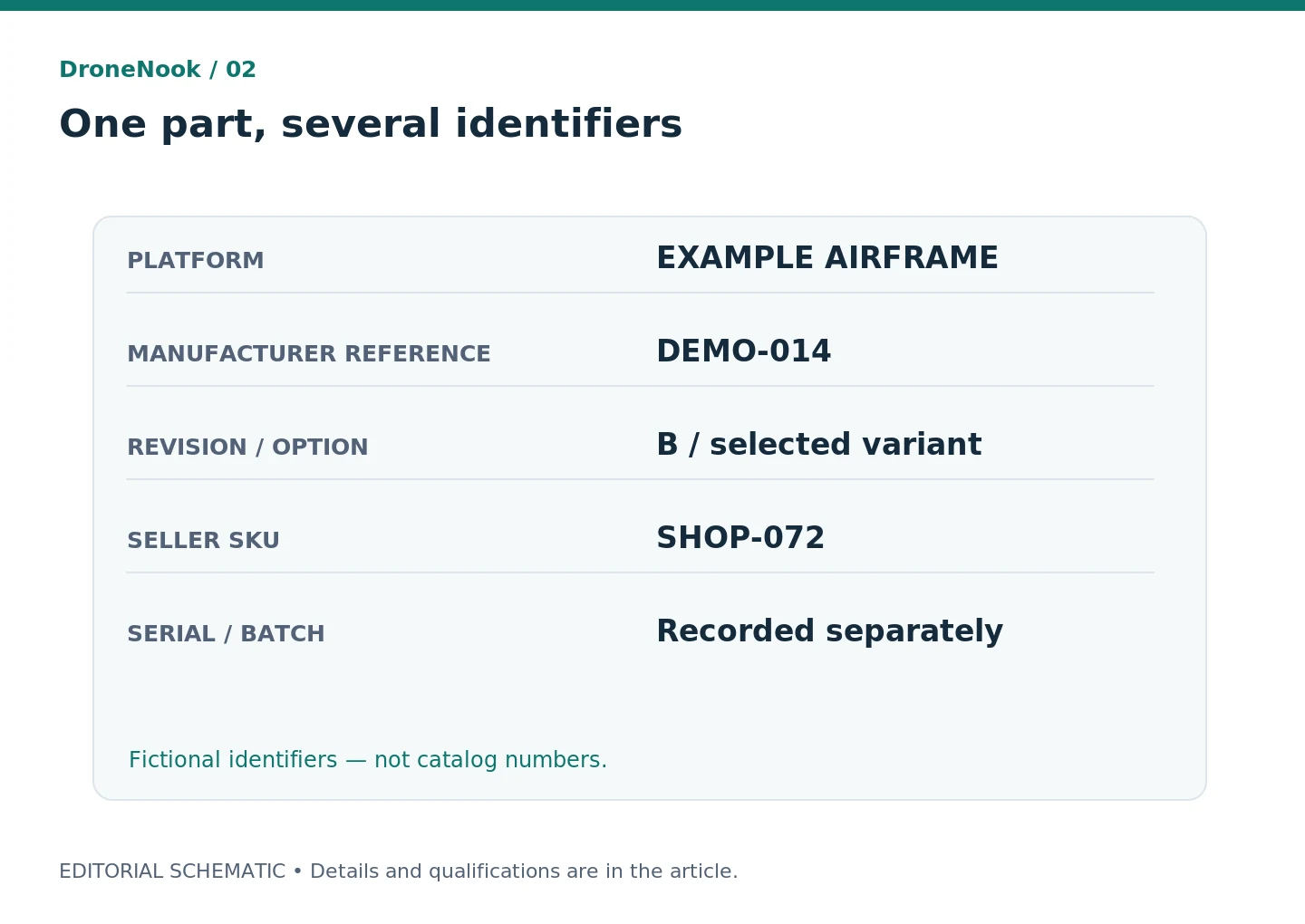
The identifiers in this diagram are fictional. Each field has a different procurement purpose.
Do not lose the selected option during copying
Some product pages show a broad model name while a dropdown determines the actual item. The EFT CN500 nozzle page, for example, presents different cable-length options associated with EP and G series. Saving only the family name omits the selected configuration.2
Use a dedicated “selected option” field rather than relying on a photograph of the dropdown. Record the seller’s exact option wording and request confirmation against the intended existing configuration. The example does not establish compatibility with a different platform.
The same method works for left/right components, connector versions, bundled accessories and material options. Do not derive any of these from a reference suffix unless the manufacturer documents its meaning.
Create a reusable identity record
The following is an editorial template. “Unknown” is a valid entry; a guessed value is not.
| Field | Record |
|---|---|
| Your internal reference | A stable code used in your purchasing sheet |
| Platform and current configuration | Existing documented equipment |
| Manufacturer / brand | As identified on the product or official record |
| Manufacturer reference | Exact characters, including punctuation |
| Revision / option | Exact wording or “not yet confirmed” |
| Seller and seller SKU | Keep separate from the manufacturer reference |
| Label photograph | File name or private file link |
| Source document | Title, revision/date and page or section |
| Replaced-by reference | Only when the replacement relationship is confirmed |
| Confirmation record | Who confirmed what, when, and with which limitations |
Keep the original reference even after a manufacturer introduces a successor. A new reference should not overwrite the old one before the relationship is recorded. “Superseded by” and “similar alternative” are different purchasing situations.
What to do when there is no reliable number
Use a two-stage process. First send an identification request, not a purchase order. Describe the equipment, function, available records and photographs. Ask the supplier to return the proposed manufacturer reference, supporting evidence and any missing information.
Second, have the responsible technical party review the proposed identity and suitability. Only then convert the request into a quotation line. Keep any alternative as a separate option until accepted.
This costs less effort than attempting to fix an ambiguous purchase after shipment. It also makes a refusal useful: if a supplier cannot identify the item reliably, the correct outcome is “not confirmed,” not a plausible substitute.
A buyer may need to return to the original integrator when a component has no public part listing. Lack of a visible code does not make the component generic. Do not remove proprietary labels or create a new brand identity to make an unknown item look traceable.
Turn the verified identity into a quotation request
Once the identity is confirmed, add quantity, unit of supply, required contents and destination. Send the supplier the source version you used and ask it to flag deviations explicitly. The RFQ checklist covers that next stage.
For mechanical parts, keep the identification record attached to the dimension-check sheet. Measurements can reveal a mismatch, but a similar measurement does not independently establish a substitute’s material or structural suitability.
Common questions
Can I search using the reseller SKU?
Yes, within that reseller’s catalog. Keep the seller name with the SKU and ask how it maps to the manufacturer reference. Do not assume another supplier recognizes the same code.
Are a model name and a part number always different?
No. Some manufacturers use a model as the ordering reference. Record the manufacturer’s naming convention rather than creating a second number. The important requirement is unambiguous identification of the item and variant.
Is the serial number enough to reorder a part?
Not usually as a standalone catalog reference. It can help the original manufacturer identify the unit, but the replacement order should state the reference and configuration the supplier has confirmed.
What if an old and a new revision look identical?
Ask for the documented revision relationship. Visual similarity is not proof that internal components, connectors or supported configurations are unchanged.
Keep the uncertainty visible
A procurement record is strongest when it states what is known and what remains unresolved. For inquiries through DroneNook, include the source of each reference and flag uncertain characters. A clear “please identify” request is more useful than a confident but incorrect number.
Sources and scope
Examples checked on 4 October 2026. The identity template and workflow are original purchasing aids. They do not provide engineering approval or imply an affiliation with the named brands.