“Complete,” “assembly,” “module” and “kit” are not interchangeable descriptions of a shipment. Define drone parts package contents with a line-by-line inclusion list, a unit of supply and explicit exclusions. Compare prices only after the offers describe the same usable purchasing scope.
This guide helps procurement teams avoid ordering an accessory package when they need a main component, or one pack when they need one piece. It does not determine whether a component is suitable for installation.
Three real listings show why the name is not enough
Fly the Farm offers a T25/T50 pump-related module and a separately named complete T50 pump. The complete-pump listing still excludes a signal cable.12 EFT also lists a nozzle-upgrade accessory package that identifies a cable and protective case in its description.3
None of those names should be expanded by the buyer into an assumed contents list. In particular, the words “nozzle upgrade” do not establish that a package contains the entire atomizing unit.
These examples are catalog observations, not a comparison of product quality or a declaration of DroneNook supply. They show that the word immediately before “kit” is not a bill of materials.
Define the unit before defining the price
A quotation may price a piece, a pair, a pack or an assembly. Ask the supplier to state how many physical units arrive for one quoted unit.
| Quoted unit | Clarification to request |
|---|---|
| Piece | One identifiable component; specify whether attached accessories are included |
| Pair | What makes the pair: two identical items, left/right items or another combination? |
| Pack | Exact number of pieces and whether all have the same reference |
| Kit | Named contents with individual quantities |
| Assembly | The boundary of the supplied assembly and any excluded external items |
| Set | A contents list; “set” alone does not define anything sufficiently |
This is especially important for maintenance buyers combining quantities from several sources. A worksheet should never use “quantity 10” without a unit column.
A simple pack-size calculation
Suppose a fictional supplier sells a verified reference in packs of two and you need 30 individual items. You need 15 packs, not 30 packs. If the invoice price is per pack, calculate the individual equivalent only for comparison; keep the actual order in the supplier’s unit.
For left/right components, 15 pairs may mean 15 of each side. Thirty individual left-hand parts is a different requirement. Preserve the orientation as part of the line item, not a note at the bottom of the order.
Use a scope matrix instead of a longer product title
The following table is a fictional format. It is not a suggested assembly or a real product configuration.
| Element | Offer A: defined main assembly | Offer B: main component only | Decision needed |
|---|---|---|---|
| Main identified component | Included | Included | Verify the same approved reference |
| Mounting bracket | Included | Excluded | Order separately if required |
| Signal cable | Excluded | Excluded | Do not assume an existing cable can be reused |
| Mounting hardware | Exact quantity listed | Not stated | Obtain a written answer |
| Protective cover | Included | Optional | Decide the purchasing scope |
| Identification and documents | Listed by reference | Listed by reference | Confirm the appropriate version |
A missing item is not automatically a defect if the quotation clearly excluded it. The procurement problem arises when the buyer expected it and nobody wrote down the boundary.
For each required accessory, ask whether it is separately available, included in another line, or intentionally excluded from the project. Do not create an extra order for an item already included elsewhere.
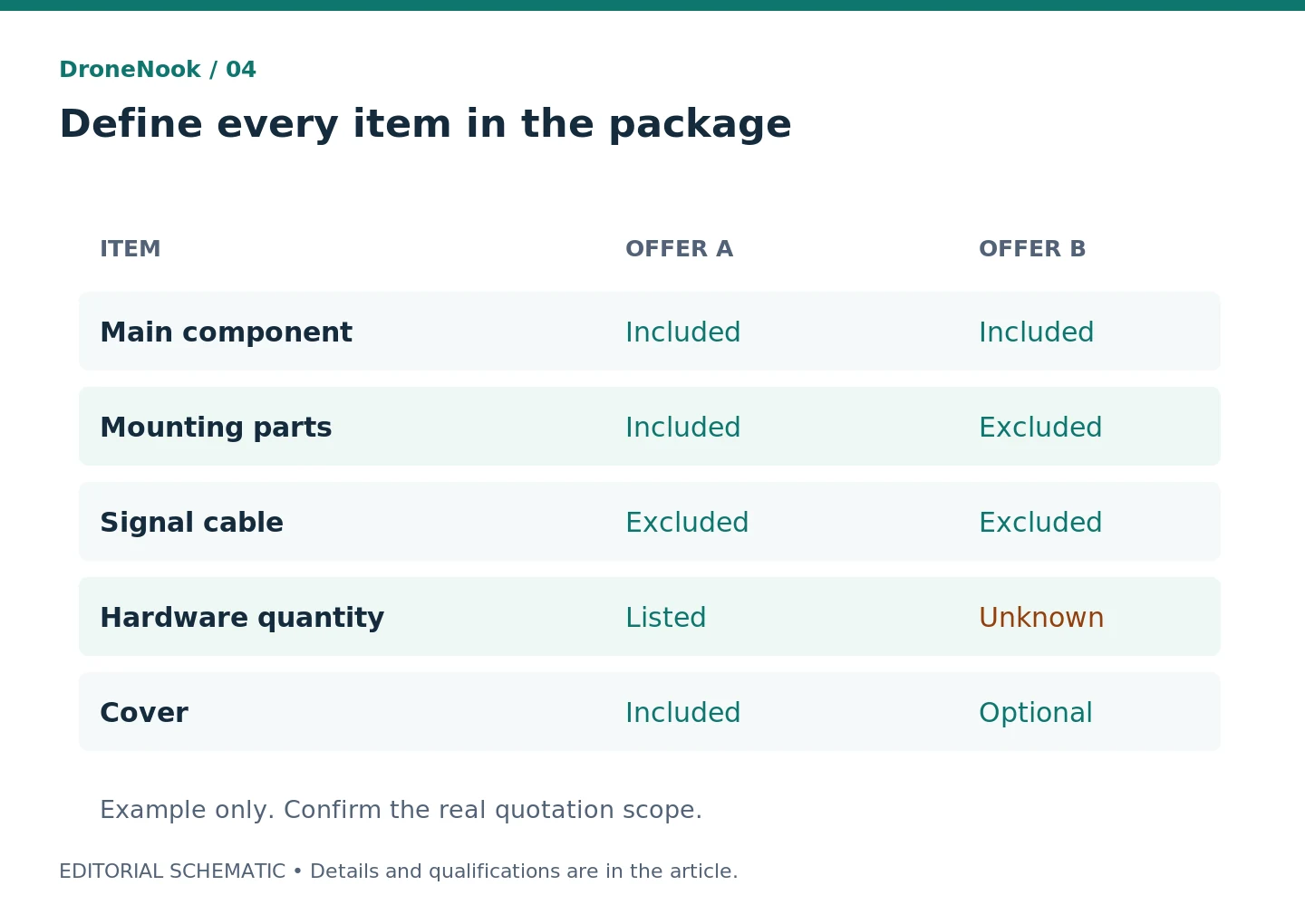
Illustrative scope comparison. “Unknown” must be resolved before an equivalent-price comparison.
Compare the whole defined requirement
Consider two fictional quotations in the same currency:
| Cost element | Quote A | Quote B |
|---|---|---|
| Main items | 900 | 1,080 |
| Additional required accessories | 120 | 0 |
| Freight for the defined shipment | 90 | 50 |
| Subtotal of known comparable items | 1,110 | 1,130 |
Quote A is 180 lower on the main items but only 20 lower on the defined known subtotal. Any remaining tax, import, inspection or other cost must be evaluated separately. Do not present this subtotal as a final destination cost when those elements are unknown.
Now consider timing: if the extra accessories in A cannot arrive with the main components, the lower subtotal may not solve the buyer’s problem. Record split-shipment conditions and dates instead of trying to compress every consideration into one unit price.
A slightly higher quote is not automatically better either. Decide against the actual requirement, including source, suitability and delivery. This worksheet is a way to compare—not a reason to prefer an expensive supplier.
Ask for an evidence set that matches the package
Request a packing list or supplier-confirmed contents table. A clear photograph can help show which loose accessories are present, but it is not sufficient when items are hidden inside packaging or a photograph is a generic marketing image.
Label the evidence with the exact quoted reference and revision. If a photo shows optional accessories, the quotation should identify them as optional. Ask the supplier to resolve contradictions between the headline, description, photograph and packing list before purchase.
For mixed orders, preserve the connection between outer carton, inner pack and item reference. This makes receiving simpler and reduces the risk of counting several small packs as one assembly.
Do not ask suppliers to remove traceability information to make the package look like a different manufacturer’s product. Neutral packaging, where legitimately agreed, is not permission to misrepresent the source.
Check three boundaries before accepting “ready to use”
Commercial completeness: Are all items included in the agreed purchase physically present?
Technical suitability: Are the identified items appropriate for the equipment and configuration? The responsible technical party must decide this.
Operational readiness: Have all required installation, inspection, calibration and other steps been completed under the appropriate instructions?
Receiving a complete box only answers the first question. Do not treat it as permission to operate the equipment. The wording in an order confirmation should not blur these stages.
The sample-request guide provides a way to separate receipt checks from technical evaluation and release.
A final order note worth keeping
The order covers only the references, revisions, quantities and included
items listed in the accepted quotation. Exclusions remain excluded.

Any proposed change to component identity, accessory quantities or
packaging units must be identified before shipment and accepted in writing.

Photographs are supplementary. The confirmed item and contents list
control the purchasing scope, subject to the final agreed contract.
Have the actual contracting parties review the final wording. This is a procurement drafting aid, not a substitute for applicable terms.
Common questions
Does a complete assembly include its cables?
Not necessarily. The cited complete-pump listing expressly excludes one cable. Confirm every required connection item rather than inferring inclusion from “complete.”2
Is a kit always cheaper than buying parts separately?
No conclusion is possible from the word “kit.” Compare the exact contents, quantities, delivery and other relevant costs. A kit can also include items your requirement does not need.
Can I ask the supplier to remove unnecessary accessories?
You can ask whether a separately defined package is available. It may change price, lead time or support arrangements. Get a revised reference or written contents list; do not rely on an informal promise that the normal kit will arrive differently.
Should I open every sealed pack at receiving?
Agree the receiving procedure with the supplier and the responsible quality party. Do not automatically break protective packaging or seals merely to follow a generic article. Use the approved inspection plan for that shipment.
Make the next quote easier to compare
Attach your scope matrix to the RFQ checklist. For a request through DroneNook, state the items that must be included and those you are ordering separately. The more clearly the package is defined, the less room there is for an attractive price to describe the wrong purchase.
Sources and scope
Listings checked on 4 October 2026. Numerical examples and tables are illustrative, not actual prices or packages offered by DroneNook.
- Fly the Farm, T25/T50 pump module.↩
- Fly the Farm, complete T50 pump and stated exclusion.↩
- EFT, 10.05.07.0055.A nozzle-upgrade accessory package.↩