
Plan agricultural drone spare parts inventory by exact reference, actual usage, replenishment time and operational consequence. Separate routine replacements from incident-related demand, and count only usable stock as available. A large fleet does not justify buying the same percentage of every spare part, and a manufacturer catalog is not a recommended stocking list.
Plan agricultural drone spare parts inventory by exact reference, dated demand, end-to-end replenishment time and the consequence of not having the item. Separate routine use, seasonal work, new-customer opening demand and one-off incidents. Count only accepted, usable stock as available.
This method is for distributors and maintenance businesses. Every numerical case is fictional: it is not a forecast, failure rate, maintenance interval, service-level promise or financial-return claim.
Create one inventory line for each approved manufacturer reference, revision, option and location. Keep incompatible variants separate even when their names or dimensions look similar. Use the part-number guide before assigning a stock code.
A catalog can help organize the register. EFT’s parts directory, for example, separates platform families and references. It does not reveal a failure rate, demand rate or recommended stock level.
| Inventory-record field | What to store |
|---|---|
| Identity | Reference, revision/option, supported configuration and location |
| Status quantity | Usable, allocated, on order, held, sample, returned and obsolete separately |
| Demand event | Date, quantity and type: routine, incident, opening order, seasonal or other |
| Supply event | Order reference, quantity, due date, confidence and acceptance date |
| Planning rule | Stock, order-on-demand, supplier arrangement or periodic review |
| Assumptions | Source, owner, date set and next review date |
Record why stock left the shelf. Planned use under the applicable process, confirmed-fault replacement, incident repair, resale, evaluation and opening stock for a new customer are different demand signals.
Do not turn one incident into weekly demand. Do not spread a short peak season evenly across the whole year and assume the resulting daily average will protect the actual peak. Keep the event date and category, then review the relevant period.
Oracle’s official inventory calculation documentation notes that normal-demand results can be approximate when demand is intermittent, promotional, strongly seasonal or skewed. That limitation matters even if the business uses a spreadsheet rather than that software.
| Situation | Possible planning result | Review trigger |
|---|---|---|
| Repeated use, stable supply | Stock with a documented reorder rule | Demand or lead-time pattern changes |
| Important but irregular demand | Small allowance, supplier arrangement or case-by-case stock | Incident, new commitment or supplier change |
| Expensive and very infrequent | Order-on-demand, unless unavailability consequence justifies stock | New project or longer lead time |
| New platform with no history | Temporary assumption, small initial quantity or order-on-demand | Short scheduled review after real demand/supply evidence |
| Obsolete, held or unverified | Exclude from usable availability | Formal disposition or approval relationship |
Budget pressure does not make every line “stock zero.” For each reference, compare unavailability consequence, lead-time confidence, substitution/borrowing options, unit cost, pack size and obsolescence risk. The result may be more stock, the same stock, order-on-demand or more frequent review.
With no history, start transparently: list confirmed commitments, a labeled supplier lead-time estimate, any applicable technical requirement, the consequence of delay and the next review date. Zero recorded demand is not proof that zero stock is the right policy.
Measure from a completed replenishment decision through confirmation, production or picking, transport, receipt and acceptance into usable stock. A dispatch estimate is not the full lead time.
Keep each observed duration with its dates. Separate estimates from history and note recent variability. An identity discrepancy or receiving hold extends usable-supply lead time even after the parcel arrives.
For a stable, simple illustration:
Reorder point = expected use during replenishment time + chosen safety allowance.
This matches the basic form in Oracle’s documentation: safety stock plus average lead time multiplied by average daily demand. Oracle also uses demand and lead-time variation for statistical safety stock; this article does not derive a service level or assume that model fits intermittent demand.
| Input | Fictional value |
|---|---|
| Expected use | 2 individual items per week |
| End-to-end replenishment time | 3 weeks |
| Chosen safety allowance | 2 items |
| Reorder point | 2 × 3 + 2 = 8 items |
| Usable items on hand | 6 |
| Confirmed items on order | 4 |
| Committed allocations not yet issued | 3 |
| Inventory position | 6 + 4 − 3 = 7 items |
The position of seven is below the illustrative reorder point of eight, so replenishment is due. With an order-up-to target of ten, the preliminary quantity is three. If the confirmed pack contains two identical items, rounding to full packs produces an order of four. None of these values is a recommended stock level.
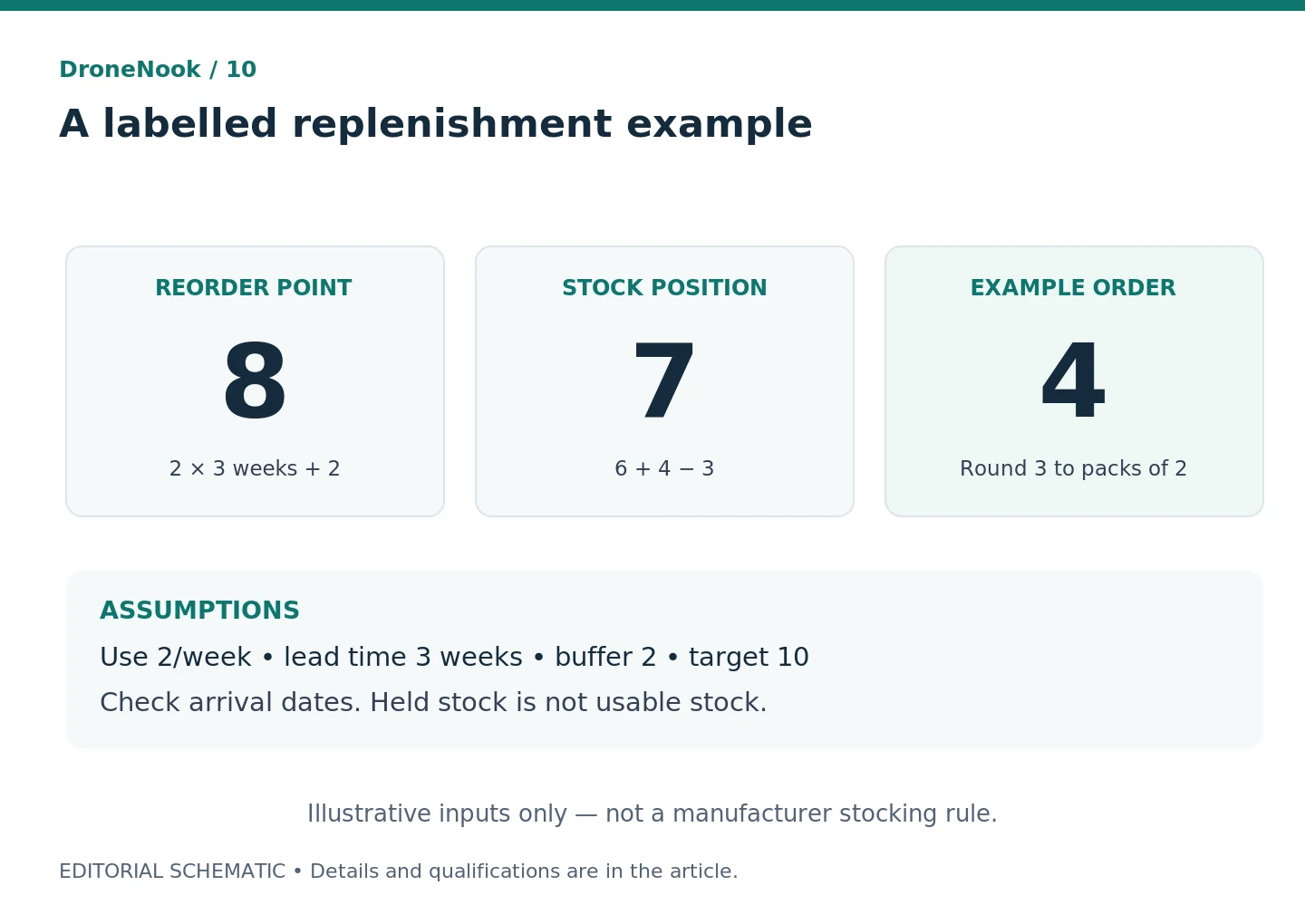
Illustrative arithmetic for one reference. Replace every input with verified business data and a documented planning rule.
In the fictional two-items-per-week case, one extra week of delay would consume two more items if use stayed unchanged. A two-item allowance covers that one chosen scenario; it does not establish a statistical service level or cover a simultaneous demand spike. Check different delay and demand cases separately before selecting the allowance.
Choose the safety allowance by recording the uncertainty it covers: demand variation, lead-time variation or an agreed consequence buffer. Then record cost/obsolescence constraints and the review date. Avoid one number that silently covers every risk and is never revisited.
Inventory position is a quantity summary, not a date promise. Microsoft’s official planning documentation distinguishes projected availability at a point in time and adds future supply on its due date. The following is a separate fictional scheduling example, not the allocation snapshot in the reorder table.
| Date | Event | Projected usable balance | Result |
|---|---|---|---|
| Day 0 | 6 usable items | 6 | Available now |
| Day 4 | 5 items due to an already recorded commitment | 1 | Only one remains |
| Day 6 | 2 more items required | −1 | Shortage of 1 |
| Day 8 | Confirmed receipt of 4 accepted items | 3 | Receipt is too late to prevent the Day 6 gap |
A negative projected balance represents unmet demand, not negative physical stock. The five-item commitment is already represented as dated demand; do not subtract it again as a separate allocation or forecast. Likewise, count the four incoming items once and only on the date they are expected to become usable.
Keep unconfirmed supplier promises separate. Review peak windows directly rather than averaging them across the year. For sparse demand, inspect each event and consequence; a smooth average can hide long zeros and sudden requirements.
Use distinct statuses for accepted usable stock, incoming stock, allocations, evaluation samples, returns, quarantine and obsolete items. A physical item with unknown revision or damaged packaging is not ready supply.
Use the actual manufacturer’s storage and handling requirements. Do not invent shelf life for seals, electronics or adhesives. When two revisions are approved as replacements, retain the documented relationship and applicable configuration rather than merging them universally.
After a shortage, classify the cause: demand event, late supply, wrong identity, receiving hold, pack-size error, duplicate/omitted allocation or outdated assumption. Each cause requires a different correction.
Review after a new customer, platform or revision; a supplier lead-time change; the start/end of a seasonal window; an incident; or a period without movement. Preserve the old rule and explain why the new one changed.
Use the RFQ checklist to request exact references, pack units, quantities and required arrival dates rather than an undefined “full range.”
No universal kit follows from fleet size or a catalog. Decide per reference from supported configurations, dated demand, unavailability consequence, supply options, cost and obsolescence risk.
State what the allowance covers, the evidence available, the consequence of shortage, the budget/obsolescence constraint and the review date. Intermittent or seasonal demand may need event-based review instead of a stable-average formula.
Include confirmed incoming quantity in position, but place it on its expected usable date. It cannot cover earlier demand. Keep uncertain promises separate.
Only after the applicable disposition and acceptance process permits it. Keep their status separate until then.
For each line, record the policy, current reason, quantity, pack unit, required date and next review date. Send DroneNook that replenishment record rather than only a fleet-size estimate. Supply, pricing, timing and suitability require confirmation.
Sources checked 22 October 2026. The inventory record, planning groups and numerical cases are editorial examples, not measured failure data or manufacturer stocking recommendations.