
A practical definition of cinewhoops, their guarded structure, filming role, and the information needed for a useful purchasing brief.
A cinewhoop is an FPV drone built around guarded or ducted propellers and commonly configured to carry a small recording camera. The guards help contain the propeller disc, but they do not make the aircraft harmless, silent, or automatically suitable for flying near people. For a buyer, the useful definition is a compact filming platform whose airframe, video system, radio link, payload, and support equipment must be specified together.
Use this three-question purchasing screen, rather than treating the labels as a formal taxonomy: Will the pilot fly from an onboard camera view? Are the propellers surrounded by a guard or duct? Is the complete build configured for the required close filming route and recording device? If the intended shot does not require this kind of onboard FPV route, compare other camera platforms against the actual shot instead. If the second is no, compare an open-propeller FPV platform separately. If the third is unknown, “cinewhoop” is only a catalog label, not a finished choice.
| Common purchasing label | What to verify for this offer | Do not infer |
|---|---|---|
| Tiny whoop | Is it a very compact guarded FPV aircraft built around light equipment? | That it carries the required recording camera |
| Cinewhoop | Is the guarded FPV build configured for a named camera and close filming route? | Image quality, payload or safe proximity from the name |
| Open-prop FPV | Are its propellers exposed and its mission based on open-space FPV? | That it can replace a guarded build on the same route |
| Camera drone | Would a different camera platform better deliver the required shot, stabilization and route? | That the category name alone establishes or excludes the required shot |
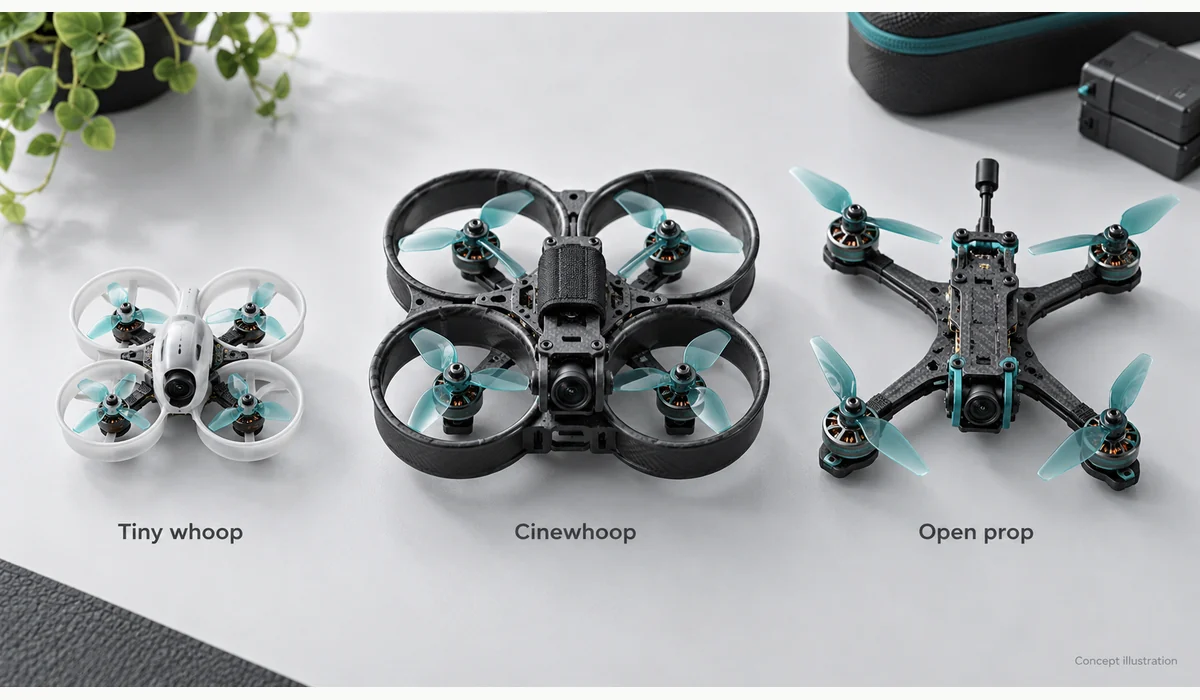
AI-generated product-form comparison; conceptual hardware, not a verified model or performance test.
The cinewhoop meaning combines two ideas. In this purchasing guide, “whoop” is a working label for the small guarded FPV builds being compared; sellers may use it differently. “Cine” points to the intent to capture controlled, usable footage, often with an onboard action or HD recording camera. The key requirement here is a pilot-view camera and a defined filming workflow; other aircraft categories can also carry cameras or offer FPV functions.
That distinction matters in purchasing. A cinewhoop is not simply a drone camera gimbal, and a bare cinewhoop frame is not a complete aircraft. The same airframe can be sold as a frame, a prebuilt aircraft, or part of a package with batteries, charger, radio, and goggles. The product name alone never defines what is included.
Understanding whoop drone meaning is a starting point. Use structure and intended work to classify an offer, rather than relying on a seller’s label.
A larger guarded FPV drone is not necessarily better for every project. More space may support a different camera or power configuration, while a smaller craft may fit tighter routes. Those are project variables, not universal performance rankings. Use the 2.5 vs 3.5 inch Cinewhoop comparison to turn those variables into route-clearance, weight and evidence checks.
The visible guard is the easiest way to recognize an FPV drone with propeller guards. It creates a physical boundary around part or all of the propeller disc and can affect the way the airframe contacts an obstacle. Its presence does not prove a particular impact rating, safe distance, noise level, flight time, payload, or permission to fly in an occupied location.
Treat every performance statement as a separate evidence request. Ask for the exact configured weight, propeller and guard combination, operating instructions, and test conditions. Inspect guards for cracks, deformation, loose fasteners, and propeller rubbing before use. The operator remains responsible for the route, exclusion area, crew coordination, and applicable rules.
Write the job before choosing a model. The following is a fictional brief that shows the required decisions:
Route: controlled pass through a 1.2 m doorway, then one slow turn
Environment: private indoor location; access controlled during filming
Pilot view: existing goggles model ___, or propose a complete matched system
Final file: 4K master required; state which device creates it
Camera: named camera or required payload envelope ___
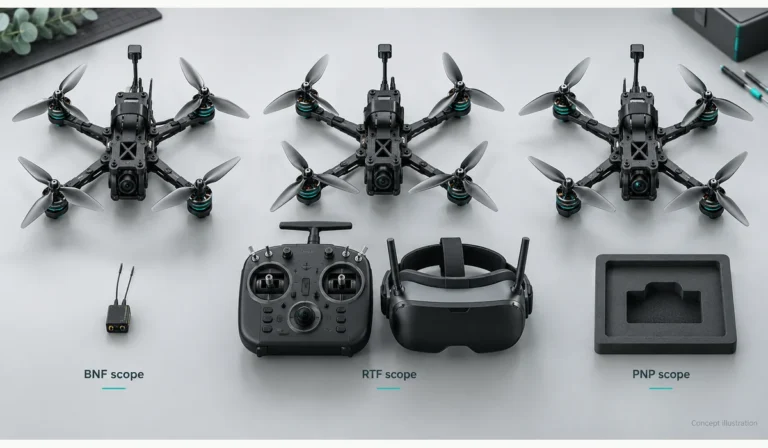
Delivery scope: mark aircraft, radio, goggles, batteries, charger and spares included/not included
If the route, camera or receiver is unknown, the result is “information incomplete,” not an automatic recommendation. If the work needs a stand-off stabilized view rather than a close FPV route, stop and compare another aircraft category.
Before requesting a quotation, fill in this six-line brief:
Knowing the cinewhoop meaning does not resolve a common category error: comparing two “cinewhoop” prices when one quote is an aircraft-only build and the other is a usable field package.
Start with the route and shot, then choose size and configuration. Confirm the video and radio ecosystems before choosing a receiver option. Ask for a package list with manufacturer part numbers or unambiguous specifications. Define inventory and documentation checks first. Any powered, control or flight evaluation must follow the exact manufacturer’s instructions under an appropriate qualified operator’s plan; missing procedures remain an open requirement.
For configuration examples, compare DroneNook’s Cinewhoop FPV Drones for guarded filming builds with its Open-Propeller FPV Drones for exposed-prop platforms. Confirm the selected configuration, radio and video equipment, and package scope before ordering.
DroneNook can review a submitted civilian application and documentation set without assuming that a listed component is available or compatible. Use the drone parts inquiry checklist to structure the request, or contact DroneNook with the route, recording target, radio/video equipment, and required package scope.
For a documented manufacturer example, the BETAFPV Pavo35 product page separates the guarded airframe and receiver options, and warns that camera and HD digital VTX are not included in all packages, so the selected package and any separate purchase must be checked. Use that model-specific listing to identify the questions to ask; it does not establish a universal cinewhoop package or DroneNook availability.